Research
Overview
Research in the Zong Group aims to discover and understand microscopic processes that underlie novel phases of matter in a non-equilibrium system, probing open questions at the interface between strongly correlated materials and ultrafast science. Unlike photochemistry in molecular systems, light-induced transitions in correlated solids present additional complexities — alternatively viewed as opportunities — in achieving a surgical control of quantum matter. These complexities arise due to the presence of (i) multiple competing or coexisting orders, (ii) spatial heterogeneities, such as topological defects and phase separation in the nanoscopic or mesoscopic regime, and (iii) vastly different time- and energy scales ranging from electron-electron scattering (sub- to few fs) to structural rearrangement (up to µs).

Research areas

Spatial heterogeneity in non-equilibrium transitions
Photoinduced phase transitions in solids are traditionally viewed as chemical reactions that proceed along a particular reaction coordinate in the phase space, where atoms move in a concerted manner towards their new positions. This picture is at odds with many equilibrium transitions where spatial heterogeneity is pronounced. Increasing evidence has shown that disorder plays a critical role in non-equilibrium transitions, where transient defects can even lead to new states of matter. We develop novel techniques to measure heterogeneities in either real or momentum space across a wide range of time scales, aiming to understand and control these spatial features as we explore hitherto unknown phases of matter.
Ultrafast phase engineering using coupled degrees of freedom
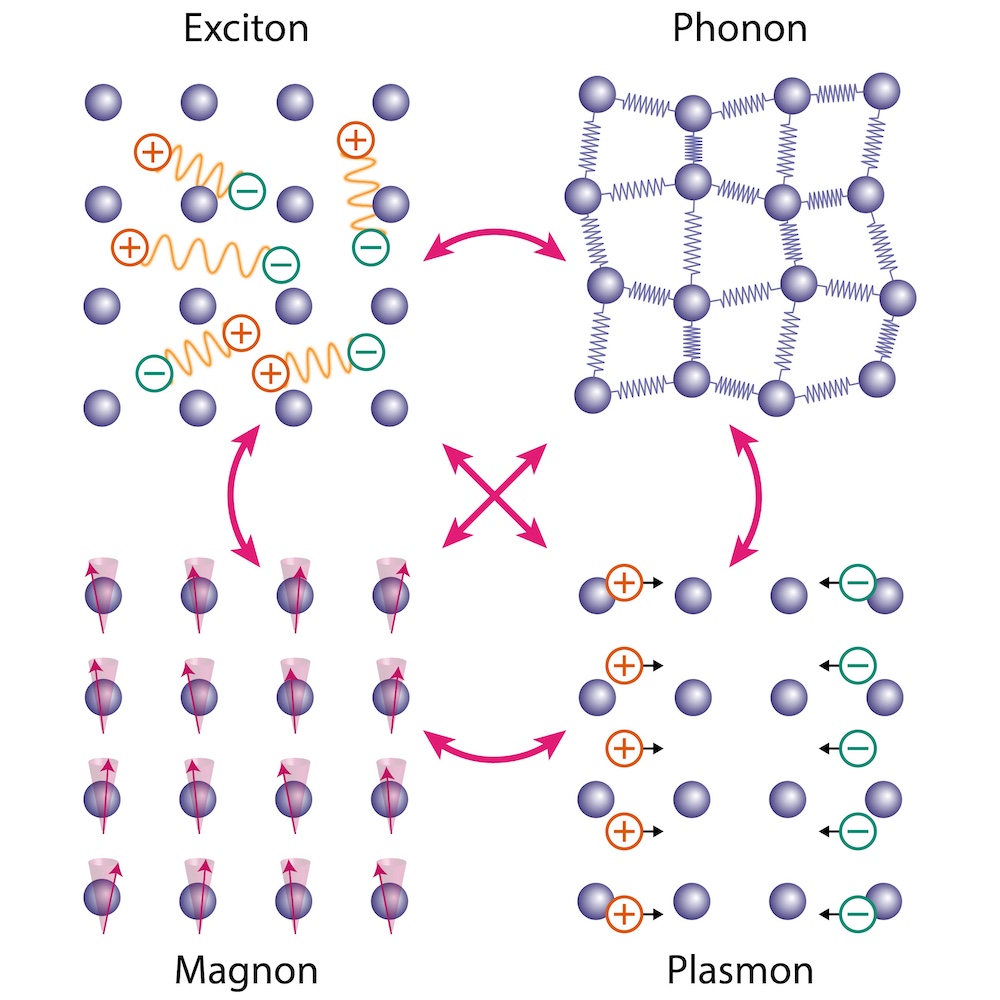
A defining characteristic of quantum materials is the presence of proximal phases of matter involving co-existing or competing orders. We are interested in leveraging the interplay between coupled orders in a non-equilibrium setting to photo-engineer on-demand properties in correlated solids. Here, tailored pulses will be used in conjunction with tuning knobs in equilibrium, such as cavity quantum electrodynamics, static strain, and electric and magnetic fields. One particular focus is on 2D material platforms, whose electronic, lattice, and magnetic properties can be precisely controlled thanks to advances in thin film growth and device fabrication.